

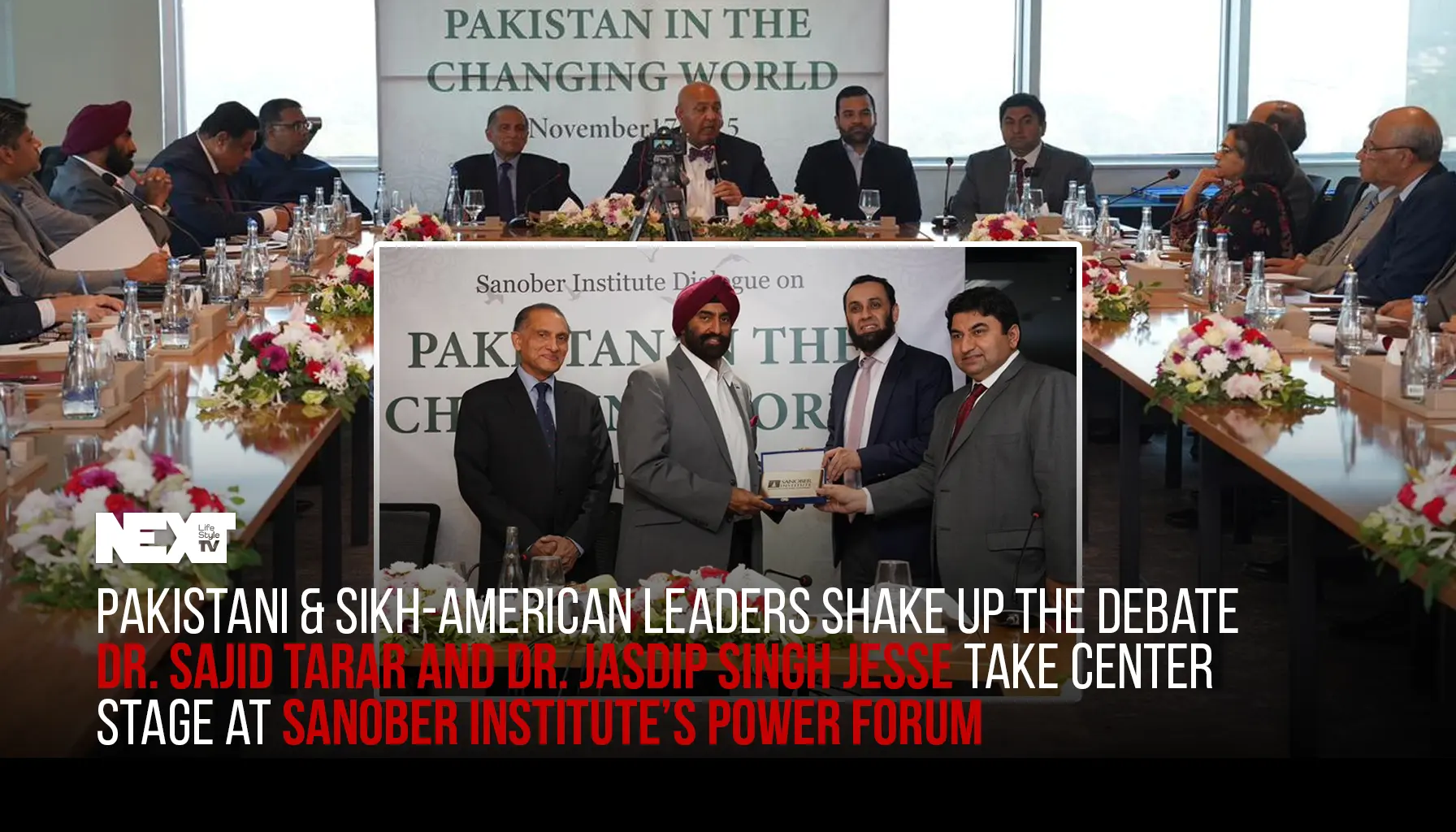

At a moment when Pakistan is recalibrating its foreign policy and economic outlook, the Sanober Institute convened a high-level dialogue titled “Pakistan in the Changing World.” This event brought together policymakers, scholars, and diaspora representatives. They examined the country’s shifting place in an increasingly competitive global order. Sanober Institute hosts strategic dialogue as U.S. diaspora voices shape debate on Pakistan’s future. This is indicative of the broader discourse shaping the nation’s direction.
Among the participants were two prominent U.S.–based community leaders — Dr. Sajid Tarar, Chairman of Muslims of America, and Dr. Jasdip Singh Jesse, Chairman of Sikhs of America. Their presence introduced a broader transnational perspective to the discussion. It highlighted how the Sanober Institute hosts strategic dialogue as U.S. diaspora influences shape debate on Pakistan’s future.
Dr. Sajid Tarar, long engaged in political advocacy and interfaith work in the United States, argued that Pakistan’s current moment requires a deliberate effort to rebuild global confidence. He pointed to the role diaspora communities can play in shaping economic linkages. They also counter misinformation and strengthen Pakistan’s external partnerships in pivotal ways.
“Countries that leverage their global communities effectively tend to negotiate better outcomes,” he said. He noted that Pakistan’s large diaspora remains an underutilized asset in diplomacy and development.
A Sikh-American Perspective on Regional Stability
Dr. Jasdip Singh Jesse, a frequent voice on South Asian interfaith affairs, emphasized the need for sustained cross-border cooperation and people-to-people engagement. This highlights Sanober Institute’s focus on hosting strategic dialogues. U.S. diaspora voices are crucial in shaping debates on Pakistan’s future. He argued that regional progress remains tied to inclusive narratives — something policymakers often overlook.
“In a fragmented region, dialogue across identities is not symbolic; it’s strategic,” he noted. He highlighted how Sikh-American institutions interact with South Asian dynamics.
A Broader Look at Pakistan’s Strategic Choices
The forum’s discussions reflected a widening consensus among analysts. Pakistan’s future will depend on its ability to navigate geopolitical realignments while managing internal restructuring. Several speakers underscored:
- the recalibration of U.S.–Pakistan relations,
- China’s evolving expectations,
- the Gulf states’ shifting investment strategies,
- and the economic reforms required to stabilize Pakistan’s fiscal trajectory.
The participation of Tarar and Jesse brought attention to an emerging theme in policy circles — the diaspora’s growing influence in shaping perceptions of Pakistan abroad. Its capacity to serve as a bridge between domestic stakeholders and international forums was also emphasized.
While the forum did not produce formal recommendations, it reinforced the need for Pakistan to broaden its policy conversations beyond traditional political actors. The inclusion of diverse diaspora voices suggested a recognition that Pakistan’s global relevance will increasingly rely on the strength of its international networks. It won’t only depend on its state institutions. This is particularly vital as the Sanober Institute hosts strategic dialogue. U.S. diaspora voices continue to shape the debate on Pakistan’s future.
In a region defined by rapid shifts and rising uncertainty, the dialogue’s underlying message was clear: Pakistan must think globally if it hopes to navigate the complexities of the years ahead.